CRM for the shopping center
The organization of the work of the shopping center turns out to be much more complicated than it might seem at first glance. It is important to establish a number of business processes and establish effective interaction between customers, landlords, tenants and other participants. The use of CRM for a shopping center allows you to systematize and structure all operations, increase their efficiency, improve communication and ensure full control over business processes.
Concept of CRM for trade facilities
The use of CRM systems in the field of trade is quite common. However, the working principle of a shopping center is different from a traditional store. The system is aimed at effective interaction with the end consumer in the B2C segment, but in the case of shopping centers, it interacts with customers in the B2B segment.
The CRM system is based on software that is installed on the company’s computers or mobile devices. It has a wide range of tasks, but the main goal is to increase sales volumes and optimize the circulation of goods. In the case of shopping centers, these tasks have recently been modified, taking on new aspects.
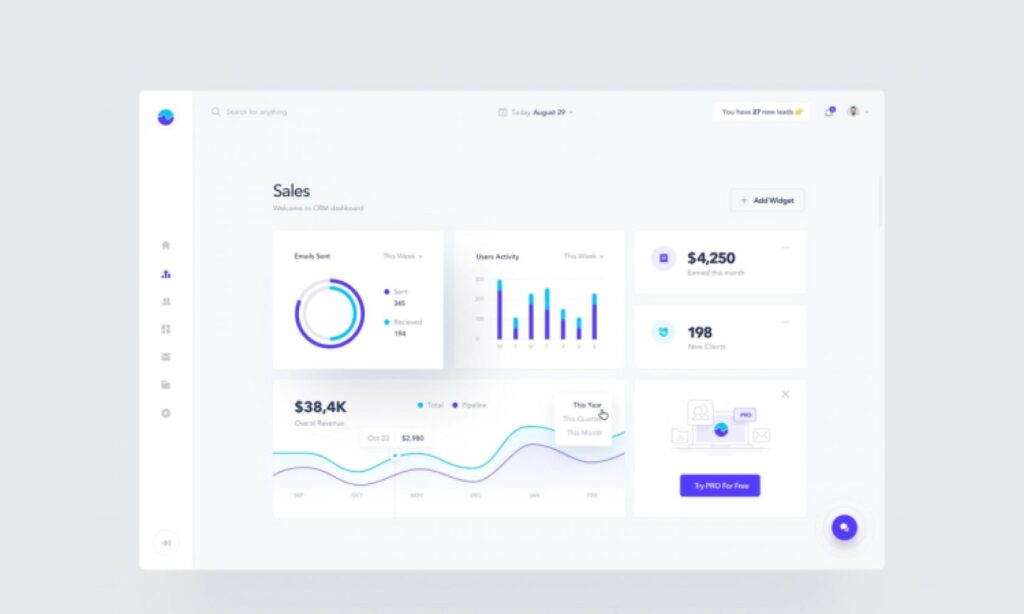
The internal logic of CRM for shopping centers is similar to traditional solutions. The only difference is that customer segmentation is done in different categories. In fact, the same tools are used with small additions and extensions. She still collects important data, structures them, forms reports, helps establish communication between the company and the client. It is simply aimed at a large flow of information and processing a large amount of data.
Functional capabilities of systems for shopping centers
Most often, CRM for a shopping center is developed individually for the company’s needs, because flexibility of settings and a high level of security are important here. But the general functionality looks like this:
- Tenant application management. In order for a shopping center to operate and generate income, it needs space tenants. For this, you need to establish communication with them, collect important information. A separate card is created for each tenant, in which the necessary data is entered. In the future, working with it will become automatic, and interaction with the client will be in the most convenient form.
- Advertising opportunities. Another way to monetize the space of the shopping center is advertising. Advertisers are a separate segment of customers that require separate work. The CRM shopping center allows you to calculate the cost of services, determine the timing of advertising releases, generate reports and evaluate the effectiveness of advertising campaigns.
- Document management. One of the complex business processes is the organization of document flow. With CRM for the mall, it becomes systematized and simplified. All documents are stored in an electronic system with a high level of security. Standard templates allow you to speed up the process of creating contracts, and a digital signature makes it possible to sign a contract remotely and at any time.
- Communication with the tenant. Fast communication allows you to quickly solve any organizational issues. Communication allows you to adjust work processes, increase loyalty and provide conditions for cooperation for the client.
Reporting and analytics from shopping centers. The system collects and archives data on business operations, making it an indispensable tool for end-to-end analytics. If necessary, it can also implement an infographic system for the presentation of data in a visual form.
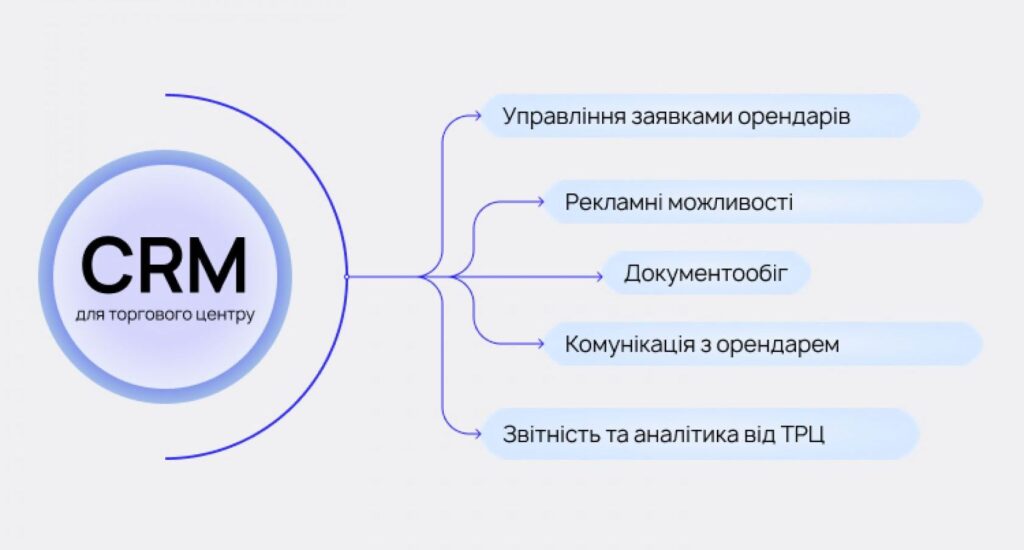
This is the main functionality provided by CRM for shopping centers. It is implemented using the development of digital tools. For each business, we choose separate solutions that help stand out from the competition. We customize the tools so that the business gets the maximum benefit.
Benefits of implementing CRM for a shopping center
For shopping malls, CRM gives the main advantage of increasing revenue. The growth of economic indicators is ensured due to high-quality work with customers, fast processing of orders, systematization of business processes and full control of the operation of the shopping center. Basically, CRM allows you to manage your company from a PC or smartphone.
In addition to increasing revenue, the system allows you to reduce costs and reduce service costs, which also affects business growth. This happens thanks to convenient communication and document flow. It’s easy to control advertising space, make schedules. The system allows you to see problems and quickly solve them, minimizing costs.
Everything is managed from a single space. It stores detailed information, the history of interaction with the lessor, and simplifies control over the work of the staff. Evaluating the effectiveness of employees allows you to rationally distribute the workload, draw up work schedules and understand the value of the staff.
The development of a loyalty program allows you to maintain the interest of the client and continue the lease. For example, during the conclusion of the contract, you can develop a system of discounts depending on the term of the lease. CRM for the shopping center is a business management tool, and this is its main advantage.
Optimizing the choice of a CRM system for a shopping center
There are quite a few ready-made solutions for business management. CRM systems in trade are widespread, there are box solutions that are quite easy to deploy. But one should take into account the peculiarities of running such a business as a shopping center. In particular, CRM must meet the following requirements:
- to be able to independently configure the interface and connect additional tools;
- perform specific tasks included in the business processes of the shopping center, for example, the calculator of the cost of renting
- the premises, taking into account the location and size of the shopping area;
- be able to scale if necessary and connect additional tools;
- integrate with third-party services and existing software.
That is why the best solution will be the personal development of CRM for the shopping center. Our specialists take into account the specifics of the business and select a set of tools that will help solve the tasks of the shopping center.
Stages of CRM development for a shopping center
The EJ Developer company develops digital products for business. Implementation of CRM in the shopping center will allow to expand opportunities and bring the company to a new level. Management will become simpler, all processes will be digitized and will be in a single ecosystem. It is reliably protected. The development takes place in several stages:
- Data collection and work planning. Analysts study the specifics of your business. We sign a nondisclosure agreement and fully immerse ourselves in your company’s processes. This will help you understand what can be digitized, automated and simplified. Based on the collected data, IT managers create a work plan, select a technology stack and develop a technical task.
- Design. It is important for us that the product is easy to use, so special attention is paid to UX design. Since you will be able to work from different devices, experts think over the arrangement of elements so that they do not overlap and interact correctly with the user. Attention is also paid to the appearance of CRM for shopping centers. The product acquires individuality, recognition and emphasizes the status of the company.
development Programmers rely on a selected technology stack and write code. This is a technically complex and lengthy process. The project has a large team dedicated to creating your product. The system is being built and the functionality is being developed. - QA testing. It is important for us that everything works like clockwork. Therefore, testing is carried out already during development, each line of code is checked. If something doesn’t work, the programmers immediately fix the problem. The security system, load level and other parameters are also tested.
- Release After we make sure that everything is working, we start the CRM implementation for the shopping center. We configure your equipment, install additional products and integrate them into the system. We train employees to use the tool and provide warranty technical support.